Our Materials
What are our prints made of?
Three things decide whether a print survives: the paper, the ink, and the machine that puts one on the other. For the prints in our shop, we use one of each, and we don't switch. When we print for other artists, we can order in the paper they already use.
The paper: Hahnemühle Photo Rag® 308 gsm
Hahnemühle has been making paper in Germany since 1584. Photo Rag is the paper most fine art printers measure everything else against.
- 100% cotton rag. No wood pulp, which means no lignin, the compound that turns cheap paper yellow and brittle.
- 308 gsm. Heavy, rigid, and substantial in the hand. It does not feel like a poster.
- Acid-free. The buffer neutralizes acidity the paper absorbs from the air over decades.
- Smooth matte surface with a faint felt texture. No glare from any angle, and no reflection fighting the image.
-
Meets ISO 9706, the international standard for paper permanence.
We buy it in 44-inch rolls, which is where our size ceiling comes from. Every print is cut from a continuous roll rather than a pre-cut sheet.
The ink: Canon LUCIA PRO II pigment
There are two kinds of ink in inkjet printing. Dye ink is colour dissolved in liquid, and it fades in light. Pigment ink is made of tiny solid particles of colour that hold up far longer.
Perenna prints with Canon’s twelve-channel LUCIA PRO II pigment set. What matters about twelve channels:
- Four black and grey channels (Matte Black, Photo Black, Grey, Photo Grey), this is what produces genuinely neutral black-and-white without the green or magenta cast cheap printers leave behind.
- Photo Cyan and Photo Magenta alongside standard CMYK, for gradients that step smoothly instead of banding.
-
Dedicated Red and Blue inks, extending the colour range past what CMYK alone can reach.
Pigment inks on cotton rag are the archival standard in the fine art world. Kept out of direct sunlight and behind UV-filtering glazing, a print made this way is expected to hold its colour for generations.
The printer: Canon imagePROGRAF PRO-4600
A 44-inch large-format printer built for photography and fine art reproduction, not signage or volume. It detects the media, aligns its own print head, and monitors the head during a run so nothing degrades halfway through a job.
It’s the same class of machine used by galleries and reproduction houses. It prints one thing: your order.
Sizes and borders
We sell three sizes. The image sits inside the sheet with a white border on all four sides, which is how fine art prints have always been presented. It gives a framer something to work with, and it means you can handle the print without touching the image.
| Sheet size | Minimum border | Maximum image area |
| 12 x 18 in | 1 in | 10 x 16 in |
| 18 x 24 in | 1.5 in | 15 x 21 in |
| 24 x 36 in | 2 in | 20 x 32 in |
Original artworks come in their own proportions, which rarely match a standard frame. Rather than crop the composition to force a fit, we centre the full image inside the sheet. On works whose proportions are far from the sheet, two of the borders can be much wider. The exact image size for each work is available on request.
Before it ships
Every print is:
- Printed to order, one at a time
- Left to dry before anything touches the surface
- Inspected for banding, marks and colour
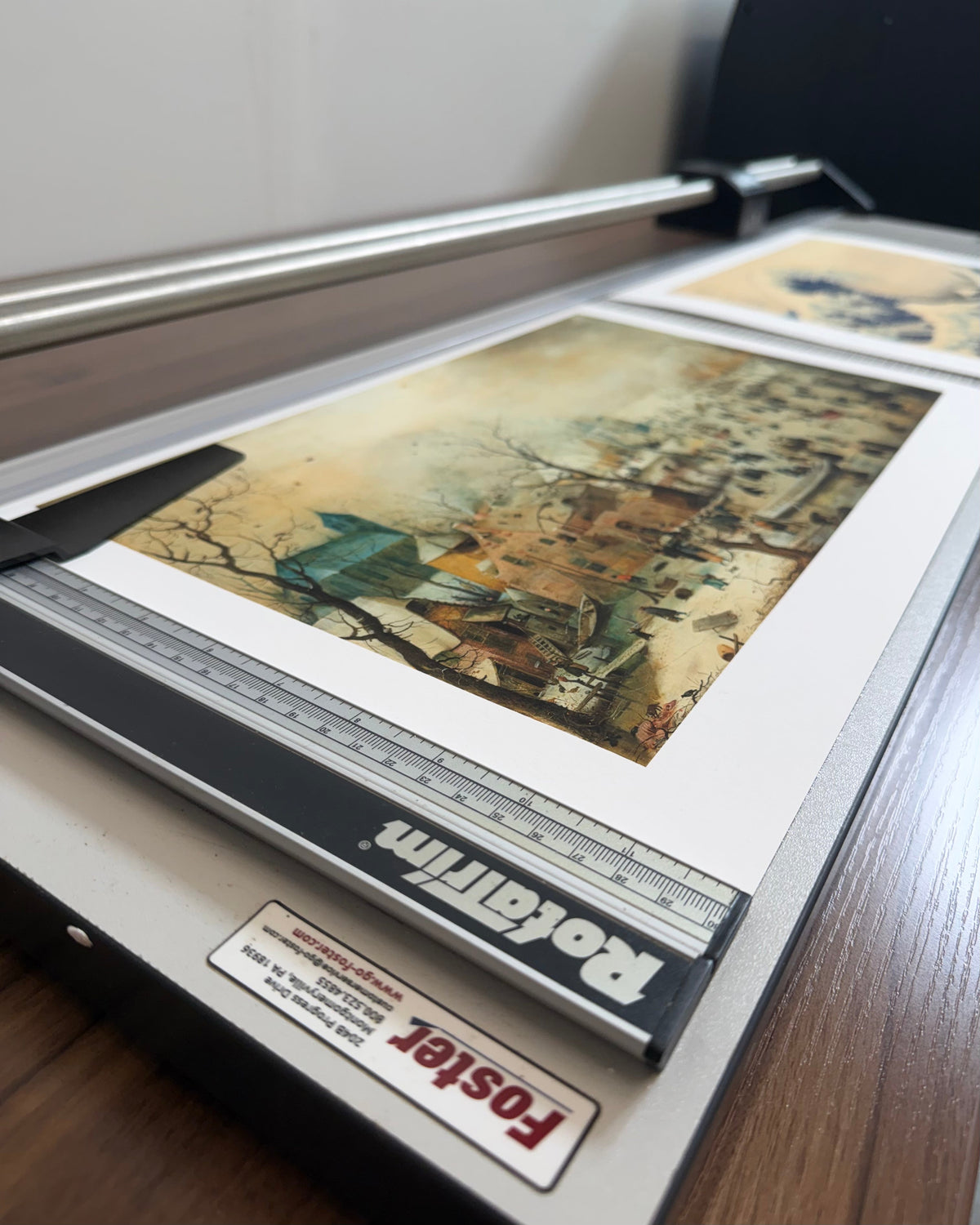
- Trimmed
- Wrapped in acid-free tissue, so nothing but archival material touches the print face.
- Rolled inside the tissue and secured, so the roll can't spring open in the tube and crease at the edge.
- Sealed in a rigid kraft tube with end caps, sized to the print so there is no room to slide.
When it arrives
Your print will have a curl from the tube. That's normal and it relaxes.
Slide it out gently rather than pulling. Unroll it face up, lay it flat under a few heavy books with a clean sheet of paper between the print and the weight, and leave it for a day. It will come out flat and ready to frame.
Looking after it
- Handle by the edges or the border. Cotton gloves if you have them.
- Frame behind glass or acrylic, UV-filtering if you can.
- Use an acid-free mat if you're matting it. Standard mat board leaches acid into the paper over time and leaves a brown halo at the edge.
- Keep it out of direct sunlight, and out of bathrooms and other humid rooms.